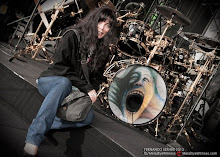
Interview and Article by Adriana Rubio
Photography and Logo: Courtesy of José Velocet
In Argentina’s heavy metal and hard rock universe,
sustaining a project over time requires much more than musical talent: it takes
confidence, constant work, and a firm commitment to self-management. With a
career that began at age 17 fronting Velocet—sharing the stage with
international icons such as Motörhead, Testament, and Yngwie
Malmsteen—José Velocet has forged a path of continuous artistic
evolution. After his time in major bands such as Ian and Entre el
Cielo y el Infierno, he now leads Resistentes, consolidating decades
of experience between the stage and production while valuing musical
independence and the relevance of a message that transcends generations.
As can be seen in the first steps—and the ones that
follow—within the music industry, there are tasks that simply must be done in
order to sustain projects, and one learns along the way. However, every
musician’s dream is to have a team that can take care of those responsibilities
so they can devote themselves fully to creating.
“You learn along the way, and that’s also really
great. Over time, within music, you end up taking on more and more tasks
because it’s the world you want to be in. Continuing to learn and adding tools
helps bring everything you envision artistically to life more effectively. I’m
a musician; I enjoy being a musician. The rest you do because you have to—it’s
not something we enjoy it that much. Since I was a kid, my path has been music, and
that’s where I am and where I want to stay.”
José Velocet began his relationship with music from when he was a child, with
early training at the Collegium Musicum until the age of 12. By 15, he
was already performing live as the vocalist of Coyote, a hard rock band
that marked his first sustained experience onstage. In 1991 he founded Velocet
with Hernán Genta, a project that became a relevant act within
independent thrash metal and remained consistently active for a decade. The
band consolidated its presence in the underground circuit, and in 1993 they
released Sangre Para el Sacrificio, a recording that proved
decisive for their musical projection. That material opened the door for
Velocet to share the stage with international references such as Testament,
Yngwie Malmsteen, and Motörhead, performing as the opening act
for their shows in the country. That stage positioned José as a recognized
figure within Argentine metal and left a significant mark on the local history
of the genre, whose international impact he would discover later on.

“Hernán Genta was the mastermind who gave
the band its name and invited me in. Together we were two kids—he was 19 and I
was 17. We started with this crazy thing without thinking much, right?
Because imagine Argentina in those years and at that age: you didn’t really
have that kind of awareness about the band, production, recordings. We really
didn’t have that consciousness; what we truly wanted was to make the music we
liked, the music on those records we listened to, the music on the poster of
that band we stared at. It was all very visceral, when you’re that age and do
what genuinely comes out of you. And that’s how we spent 10 years together; it
set the course for all of us.”
“When we opened for Testament, I always
say it was the first time I played two nights in a row, because the activity
you had as an independent band at that age meant you could play once or twice a
month, maybe, especially in the thrash metal scene. So I remember being 20 or
21 and it was already crazy to wake up the next day and say, ‘Hey, today I’m
doing that again.’ I mean, that had never happened to me in my life. And it
also marked me to share the four days they were here. Even though I was young,
they liked me, I made friends, I spent every day with them, and after that
weekend I realized, at 20, that they weren’t going back to their lives the way
I was; they were continuing on tour doing this. We began to experience things
that weren’t so common at the time. Then came Malmsteen, opening for him at
Obras Stadium, and not to mention when we got to open for Motörhead—it was
like… what more could you want?!” (laughs).
José
notes that Velocet’s identity emerged from a very balanced combination:
while he and Willy contributed musically, Hernán was mainly responsible for the
lyrics. That dynamic, together with the fact that all three were avid
readers, musically trained, and strongly shaped by the street, defined the
band’s distinctive language.
He points out that, when revisiting those songs, he is
still surprised by the level they reached at such a young age while working in
an independent context. He especially admires the lyrical quality Hernán
brought, a notable difference compared with other bands in the scene.
He also values the lasting relevance of "Sangre Para
el Sacrificio", on current tours with other projects, even outside the
country, younger generations approach him with the album for him to sign. For
José, that permanence confirms that what they did back then—born from passion
and without overthinking it—continues to resonate. That certainty is what
guides his work today in Resistentes and reinforces his confidence in
his own musical identity.
Velocet disbanded in 2001 after ten years of activity.
José remembers that the ending was disorderly and without a clear explanation,
although the members maintain a good relationship and continue to collaborate
occasionally. José returned to studying music and took part as a guest in
different shows and recordings, without a stable project but remaining active
in the scene.
In 2006 he joined Ian,
which was finishing Tiempos de Redención, and he still enjoys a
period marked by national and international tours; he also continues performing
at various national events with a Riff tribute band.
The project Entre
Cielo y el Infierno took shape in 2019, after a previous
gathering in 2017 where several bands connected to the original album (Rata
Blanca) came together. After a pause following the death of Guillermo
Sánchez, original bassist of Rata Blanca and Mala Medicina, the idea finally
came to fruition. José emphasizes that the current lineup is practically the
same one he began playing with in 2006, which is why he considers this stage a
natural continuation of two decades of shared work, stages, and international
tours, where they are highly acclaimed in Mexico. We send greetings to the
audience in Mexico, since at this moment Gustavo Rowek, Sergio Berdichevsky,
Mario Ian, Hernán Cotelo, and José Velocet are on Mexican soil!

“It’s very nice. I also went to Mexico
with Ian, so in these tours we’ve done with Ian through several countries,
Mexico was one of the countries where we were present more than once, so it’s
good to go back. It’s very nice to go play in other places, where people have
different customs, a different idiosyncrasy. Beyond the fact that they know the
songs and go to the show knowing what they’re going to see, you go to another
place as who you are, and there are expectations around that—seeing how they
receive it, how they react—and a very beautiful atmosphere is created.”

And so we arrive at the greatest part of the interview: a journey through 37 years of musical career that
is not easy to condense, especially in an era when life seems to accelerate and
shrink into threads, brief posts, and fleeting comments on social media. But it
is also necessary to pause, read, and understand an artist’s full story.
Nothing happens overnight. A career like this is built on much more than
talent: it demands self confidence, perseverance, and
sustained behavior over decades.
Resistentes was born during the period when José was playing
throughout the country, especially at motorcycle rallies. During that time, he
managed to consolidate a stable lineup with Ricky “el Griego” Alonso on
drums, Walter Scasso on bass, Diego Gregorutti, el Napo on
vocals, and himself as guitarist and singer. With that group, they toured much
of the country and maintained intense activity for three years. José had a
great deal of music that did not quite fit the project he was involved in at
the time, Ian, which was mainly oriented toward heavy metal. That
material had another sensitivity, another search, and did not strictly follow
the genre’s codes. That creative difference was the seed that drove the birth
of Resistentes.
“And at one point
I said, ‘Hey, I’m playing with these people who are iconic musicians, and I
have songs.’ So I proposed it to them and said, ‘Look, I have these songs if
you want to play them,’ and they liked the idea, and that’s when we started
working on it. Napo had a family matter, stepped away for a while, and I wanted
to keep going with this, so we started doing these songs I had. The truth is
that the band came about because I had songs and we started doing them, and it
was great. I began to notice that things were really fantastic with them, and
one day I happened to run into Chino, who had been Ian’s guitarist in 2015,
2016. In fact, we had also gone to Mexico together. The conversation happened:
‘What are you up to?’ And I told him, ‘Look, I’m putting this together,’ and he
said, ‘Why didn’t you call me?’ And that’s how Resistentes
was formed.”

“The pandemic hit
us just when we were about to go out. Luckily, we already had something
recorded, like a pre-production. And during the pandemic, I honestly realized
that we were going to stop existing before we had even existed. So I said, no,
no, no. I started reviewing what we had, and the truth is the pre-production
was good, so we worked on it; and we also had time, because at that moment
nobody was doing anything. So despite what the pandemic was, for me it was very
positive and productive artistically because the band emerged. We really came
out at a time when everything was stopped, right? We finished mixing the songs
we had, which were the first three we released; we were able to come out with
recorded songs, with a video, and start existing as a band. So from then on we
have been Resistentes and with this lineup—which, well, has only changed its
drummer because Griego is playing with JAF, and it demanded more and more time,
which we couldn’t get—but the rest of the band is the same and we keep moving
forward.”
WHY
RESISTENTES?
“When you’re looking for a name, it’s complicated. My
name is José because someone thought of it before, but if I had had to think of
it myself, maybe I’d still be nameless, who knows (laughs). But well,
Resistentes—yes, actually it’s something very simple. For us, resistants really
means staying true to who you are. And that’s what we are musically and
artistically. So that’s what it’s about; and the truth is that when I started
talking about this project with the guys, they agreed that it would be a project
without too many artistic conditions or restrictions. We didn’t want to have a
musical style limit, to be boxed into something, because we really are people
with long careers, many years in this, and we’ve played many different styles.
In my case, I played thrash metal with Velocet, I played other things, rock and
roll, blues, then heavy metal with Ian—in other words, a long career of 37
years onstage. And the same goes for the rest of the members, even more so in
the case of Sacasso and Griego. We are people with a lot of experience, having
played so many different styles, and everything we’ve listened to since we were
kids, all the records we’ve enjoyed and the music we continue to absorb—so
that’s a lot of artistic and musical baggage to say, ‘I’m only going to do this
style.’ The plan was really to do what comes out of us and say, this is our
language, this is our music, and make it without thinking so much about who
will like it, who won’t, or what style we are. The most beautiful thing about
Resistentes is finding a place where we are who we are and are free to do what
we are without so many conditions. The truth is, that is what most defines the
band.”
Listen to them on Spotify!
On September 21, José Velocet will return to
the country from his tour of Mexico with EECYEI and will have ten days to focus
fully on Resistentes and preparing for the next show. The concert on October
2 at Colombo will mark a key point: the band has just recorded new
material that will be part of its next EP, and those songs will be presented
live for the first time that night. For him, this moment represents a creative
turn and a confirmation of Resistentes’ current direction. There is unreleased,
solid, renewed music ready to come to light. That is why the October 2 show is
not just another date.
“Yes, yes, on Friday, October 2, Resistentes is
playing and presenting new songs, so come. Those who already know us, I know
you’ll come; those who don’t know us, come see what it’s about, because in the
end, if you don’t like it, you don’t come back—but at least give it a try.
That’s what life is about. So come try Resistentes; you’ll probably find
something that surprises you, and we’ll be there. Later you’ll see the promos
and all those things, but come see Resistentes because I, José Velocet, recommend
it to you.”
Resistentes current lineup is:
José Velocet: Vocals
and Guitar
Marianao Barret: Guitar
Walter Scasso: Bass
Simone Pirruccio: Drums
Buy tickets for October 2nd
THANK YOU SO MUCH JOSÉ VELOCET